
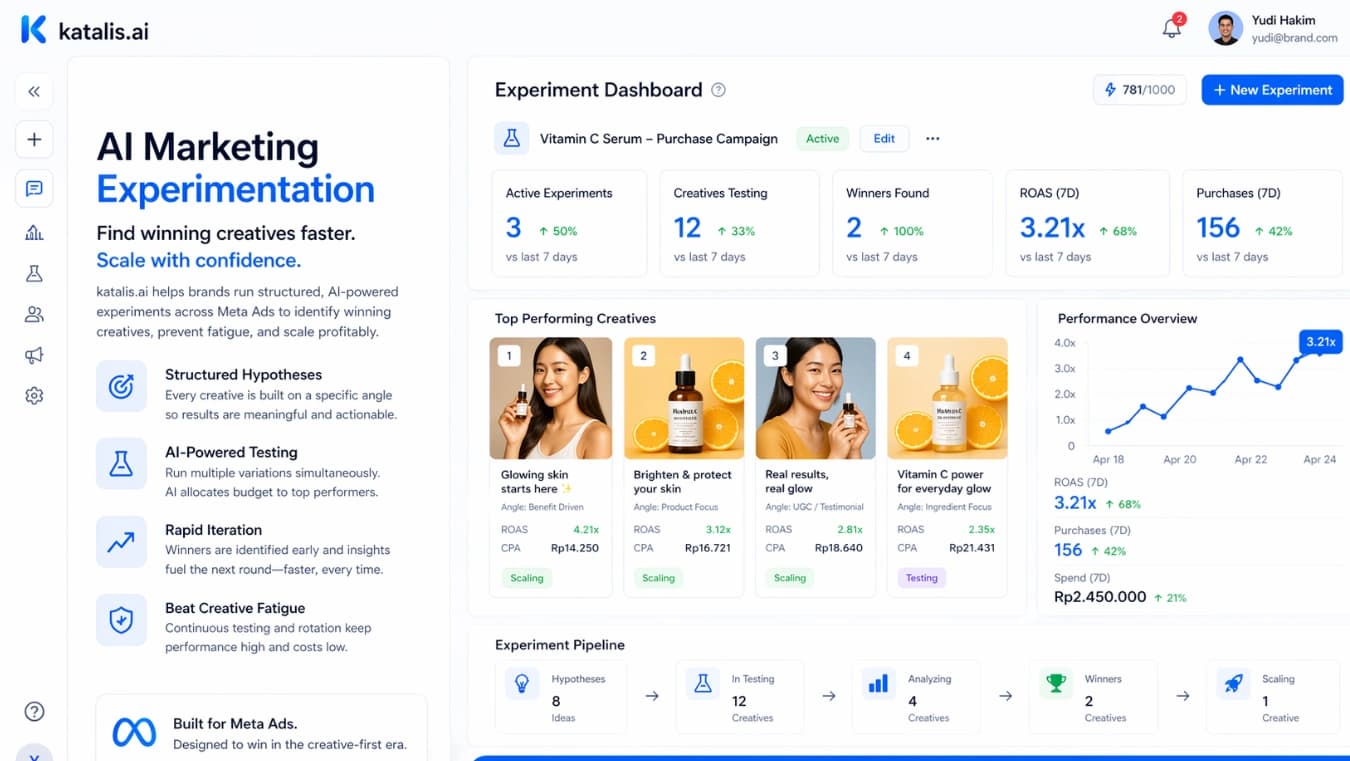
AI Marketing Experimentation: The New Requirement for Meta Ads Performance
If your Meta ads are underperforming, the problem is probably not your budget. It's not your targeting either.
It's your creative — and how fast you're replacing it.
Meta's algorithm has fundamentally changed how it distributes ads. Where brands once competed on audience targeting precision, the platform now uses creative signals to determine reach. The creative itself tells Meta who to show the ad to. This shift, accelerated by iOS privacy changes and the rollout of Advantage+ campaigns, means one thing for brands: creative quality and creative velocity are now the primary performance levers.
Brands that can test creatives fast, identify winners early, and scale before fatigue sets in will win. Those that can't will watch their ROAS erode — even with strong products and healthy budgets.
What Changed on Meta — And Why It Matters
Meta's move toward a creative-first algorithm is not a minor platform update. It is a structural change in how performance marketing works.
In the previous model, marketers invested heavily in audience construction — building detailed interest stacks, layered custom audiences, and lookalike pools. Creative was important, but targeting was the primary variable. A mediocre creative could still perform if it reached the right audience.
That dynamic no longer holds. Meta's Advantage+ system now interprets creative content — visuals, copy, format, tone — and uses those signals to model the most relevant audience. The creative is the targeting.
This means:
- Broad targeting outperforms narrow targeting when creative is strong
- Creative fatigue directly causes performance decline, often within 10 to 14 days
- The brands producing and testing the most creative variations have a structural advantage
- A single winning creative, scaled without rotation, will decay — regardless of budget
For most brands, this requires a complete rethink of how marketing experiments are structured and executed.
The Problem With Manual Creative Testing
Most brands know they need to test creatives. The challenge is doing it systematically at the speed Meta now requires.
Manual testing processes are slow. A typical brand-to-agency creative cycle — brief, produce, review, approve, upload, wait for data — can take two to three weeks. By the time results are statistically meaningful, the creative is already approaching fatigue.
The other problem is volume. Effective creative testing requires running multiple variations simultaneously across different angles — transformation, testimonial, product demonstration, social proof, urgency. Each angle needs to be tested with different hooks, formats, and visual treatments. This is not a task for a small team managing campaigns manually.
Without a structured system, most brands end up running one or two creatives at a time, drawing inconclusive results, and cycling slowly through variations. They find winners late and scale them too conservatively — or miss them entirely because the data window closed before they acted.
How AI-Powered Experimentation Works
AI marketing experimentation replaces the slow manual cycle with a structured, data-driven testing system that operates continuously.
At Katalis AI, experimentation is built around three operational layers.
Structured creative hypotheses. Every creative variation is built around a specific marketing angle. Rather than producing random variations, the system defines what is being tested — hook type, creative format, messaging angle — and assigns each variation a clear hypothesis. This means results are interpretable, not just observable.
Simultaneous multi-variant testing. Instead of testing one creative at a time, the system runs multiple variations in parallel across defined audience segments. Performance signals — click-through rate, cost per result, video retention, conversion rate — are monitored continuously. Variations that underperform are paused early; variations showing positive signals receive incremental budget.
Rapid iteration from data signals. When a creative variation shows strong performance, the system identifies which specific elements are driving results — the hook, the format, the visual treatment — and feeds that learning into the next round of production. This creates a compounding improvement loop rather than a one-off test.
The result is a significantly shorter cycle from creative concept to scaled winner. What takes a manual process three to four weeks can be compressed to seven to ten days with structured AI-assisted experimentation.
What Gets Tested
Effective experimentation covers multiple creative dimensions simultaneously.
Hook formats — the first three seconds of a video or the headline of a static ad. This is where attention is won or lost. Different hooks work for different audiences: curiosity-driven, problem-statement, social proof, transformation before-and-after, and direct benefit statements all perform differently depending on product category and audience segment.
Creative formats — static image, short-form video, carousel, and user-generated content style all have different performance characteristics. The right format depends on where the audience is in the funnel and what action is being optimized.
Messaging angles — the core argument of the ad. For the same product, a price-value angle, a transformation angle, a credibility angle, and a lifestyle angle will each attract different buyers. Testing multiple angles reveals which message resonates with the highest-value segments.
Visual treatment — color, layout, text overlay density, and motion speed all affect performance. These variables are often deprioritized in manual testing but can produce significant performance differences.
Creative Fatigue Is Not a Risk. It Is a Certainty.
One of the most important realities of running Meta ads in 2025 is that creative fatigue is not a possibility to be managed — it is a certainty to be planned around.
High-performing creatives will decline. The question is not whether fatigue will happen, but how quickly your system can identify it and replace the creative before ROAS degrades significantly.
Early fatigue signals include rising frequency per user, declining click-through rate at stable spend, increasing cost per result, and falling video view rates on formats that previously performed strongly.
Without a systematic experimentation pipeline, brands are reactive to fatigue — replacing creatives after performance has already dropped. With an AI-powered experimentation system, brands are proactive — always running the next cohort of test creatives, so replacements are ready before the current winner declines.
Why This Matters More for Indonesia, Malaysia, and Singapore
The Southeast Asian market adds additional complexity to creative testing.
Consumer behavior varies significantly across Indonesia, Malaysia, and Singapore — not just by language, but by platform behavior, content format preference, and purchase trigger. What performs on TikTok in Indonesia may not translate to Meta in Malaysia. A direct response creative that converts in Singapore may read as too aggressive in the Indonesian market.
Effective experimentation in this region requires testing across market-specific variables: Bahasa Indonesia versus English versus Bahasa Malaysia copy, local visual references, culturally relevant hooks, and platform-native formats. Brands that treat Southeast Asia as a single audience consistently underperform against those that test market-specific creative variations.
Katalis AI operates across ID, MY, and SG with localized creative experimentation built into the process — not as an add-on.
Where Katalis AI Fits In
Katalis AI was built for the creative-first era of performance marketing.
Our experimentation system enables brands to:
- Run structured creative tests across multiple angles simultaneously
- Receive clear performance signals within seven to ten days rather than waiting three to four weeks
- Identify winning creative elements and feed them into the next production cycle
- Maintain a continuous pipeline of fresh creatives — so fatigue never catches up
- Scale winning variations confidently with data, not guesswork
For brands running Meta, TikTok, Shopee, and Tokopedia campaigns across Southeast Asia, this is not a nice-to-have. It is the operational foundation of sustainable performance.