
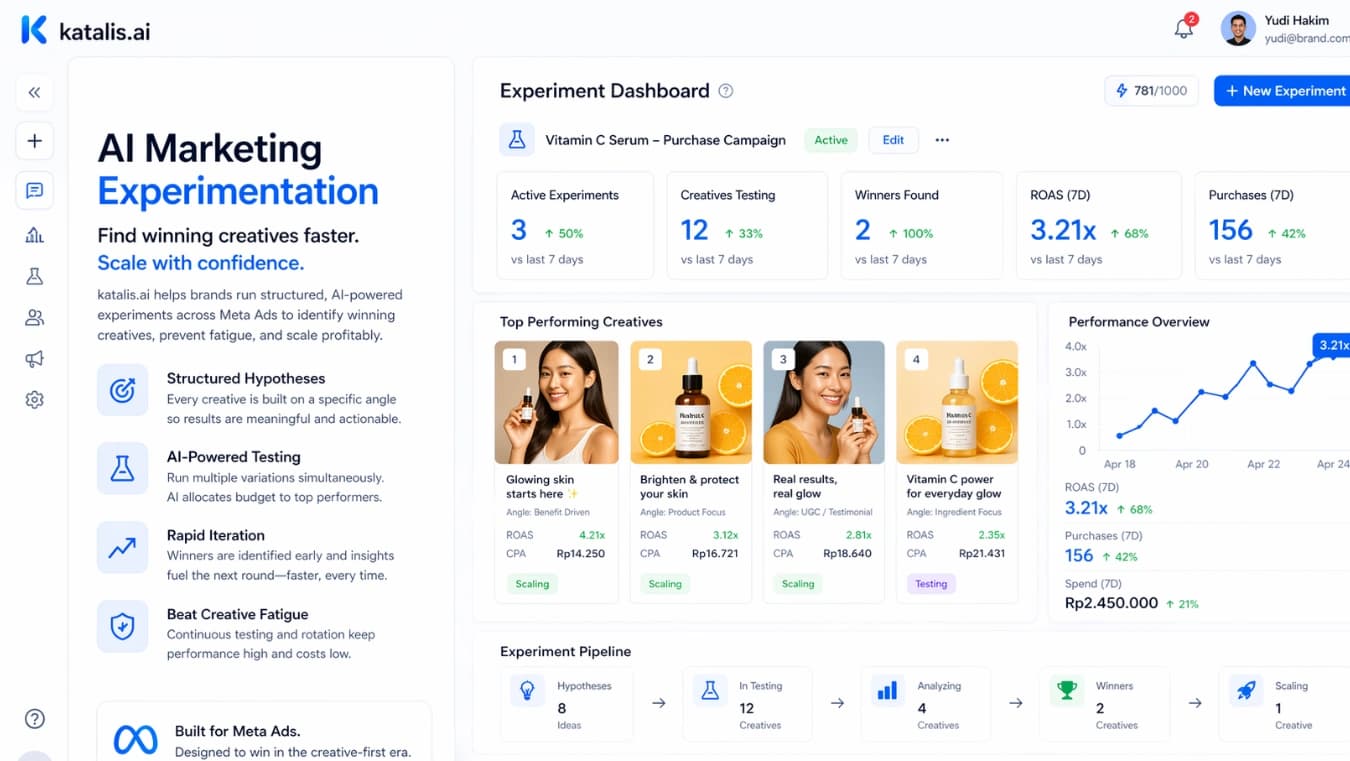
AI Marketing Automation: How to Scale Ad Performance Without Scaling Your Team
Running digital ads in 2025 is not a set-and-forget activity.
Every campaign requires continuous decisions — adjusting bids when auction costs shift, pausing underperforming ad sets, reallocating budget toward what's working, monitoring frequency before creative fatigue sets in, and responding when platform algorithms change behavior overnight. Done manually, this is a full-time job. Done poorly, it is the primary reason performance marketing budgets are wasted.
AI marketing automation replaces this manual operational burden with a system that monitors, decides, and acts continuously — faster than any human team can, and without the inconsistency that comes from manual processes.
What Manual Campaign Management Actually Costs
Most brands underestimate how much of their marketing performance is lost not to bad strategy, but to slow execution.
A campaign that needed a bid adjustment at 2pm on a Tuesday gets reviewed at 10am the next morning. An ad set that started underperforming on Friday runs through the weekend because no one was monitoring. A budget that should have been reallocated to a high-performing creative stayed distributed evenly because the weekly optimization cycle hadn't arrived yet.
These are not edge cases. They are the daily reality of manual campaign management — and each delay is a direct cost to performance.
Beyond reaction time, manual management also introduces inconsistency. Different team members make different judgment calls on the same signals. Fatigue, workload, and attention gaps affect decision quality. As campaign complexity grows across multiple platforms, products, and markets, the manual approach breaks down faster than most teams expect.
What AI Marketing Automation Does Differently
AI marketing automation operates on a fundamentally different model. Rather than reviewing campaigns on a scheduled basis, the system monitors performance signals continuously and acts on predefined rules and learned patterns — without waiting for a human to notice and respond.
At Katalis AI, automation is applied across the full campaign lifecycle.
Bid and budget optimization. The system monitors auction dynamics in real time and adjusts bids to maintain target cost-per-result without overspending during low-competition windows or losing ground during high-competition periods. Budget is reallocated automatically toward ad sets and creatives that are generating the strongest return signals.
Audience management. As campaign data accumulates, the system identifies which audience segments are converting at the lowest cost and shifts delivery accordingly. Audience pools that show fatigue signals — rising CPM, declining CTR — are deprioritized or refreshed before performance deteriorates significantly.
Performance monitoring and alerting. Rather than discovering problems during weekly reviews, the system flags anomalies as they occur — sudden CPM spikes, declining ROAS, creative frequency thresholds — and applies corrective actions immediately.
Cross-platform coordination. For brands running across Meta, TikTok, Shopee, and Tokopedia simultaneously, manual coordination across platforms is operationally expensive and error-prone. Automation consolidates campaign intelligence and allows budget and messaging decisions to be made with full cross-platform visibility.
The Difference Between Automation and Just Boosting Posts
A common misconception is that boosting posts or using Meta's built-in Advantage+ campaigns constitutes marketing automation. It does not.
Boosting a post applies a budget to an existing piece of content with minimal control over placement, optimization objective, or audience logic. It is a blunt instrument that trades control for convenience.
Advantage+ campaigns automate some placement and audience decisions within Meta's ecosystem — but they operate within Meta's objectives, not yours. They do not coordinate with your TikTok campaigns. They do not adjust based on your Shopee conversion data. They do not pause when creative fatigue hits a threshold you define.
True AI marketing automation is platform-agnostic and brand-specific. It operates according to your performance targets, your budget rules, and your business logic — not the default settings of a platform optimizing for its own ad revenue.
Why Automation Matters More as You Scale
For brands running small budgets across one or two campaigns, manual management is manageable. The real cost of not automating appears when scale increases.
More campaigns mean more variables to monitor. More products mean more ad sets. More markets — Indonesia, Malaysia, Singapore — mean more localized decisions to make simultaneously. At a certain point, the complexity of managing campaigns manually exceeds what any team can handle without performance suffering.
Automation removes the ceiling. A system that can monitor and optimize ten campaigns can manage a hundred with the same consistency. A team that was previously bottlenecked by manual operations can redirect attention toward strategy, creative direction, and business decisions — the areas where human judgment adds the most value.
This is the compounding advantage of AI marketing automation: performance improves as data accumulates, and operational capacity grows without proportional headcount increases.
Automation Across the Southeast Asian Market
Running campaigns in Indonesia, Malaysia, and Singapore introduces variables that make automation even more valuable — and manual management even more difficult.
Platform behavior varies by market. Indonesian consumers on TikTok respond to different content formats than Malaysian consumers on Meta. Auction costs and peak engagement windows differ by country. Shopee and Tokopedia campaign mechanics operate differently from Meta and TikTok, requiring separate optimization logic.
Managing this complexity manually across markets means either accepting suboptimal performance in some markets or building a larger operations team than most brands can justify. Automation handles the market-specific optimization layer continuously — without the overhead.
Katalis AI has built its automation infrastructure specifically for the ID, MY, and SG market context — including localized platform integrations, market-specific performance benchmarks, and cross-border budget logic for brands operating across the region.
What Automation Does Not Replace
AI marketing automation handles operational decisions at speed and scale. It does not replace strategic thinking, creative direction, or brand judgment.
The system optimizes toward the objectives you define. Defining the right objectives — the right balance between acquisition cost, lifetime value, and brand positioning — requires human strategic input. Producing creative that connects emotionally with your audience requires human creativity. Understanding your customer and your market requires business knowledge that no automation system can generate independently.
The most effective use of AI marketing automation is not replacing your marketing team. It is removing the operational burden that prevents your marketing team from doing the work that actually requires them.
Where Katalis AI Fits In
Katalis AI was built to handle the operational complexity of performance marketing at scale across Southeast Asia.
Our automation system enables brands to:
- Optimize bids and budgets continuously — not on a weekly review cycle
- Manage audience delivery across Meta, TikTok, Shopee, and Tokopedia from a unified performance view
- Respond to performance anomalies in real time, not after the damage is done
- Scale campaign complexity without scaling headcount
- Free up internal teams to focus on strategy, creative, and business growth
For brands serious about performance marketing in Indonesia, Malaysia, and Singapore, manual campaign management is the bottleneck. Automation is how you remove it.
Ready to Achieve Similar Results?
Let's discuss how Katalis AI can help transform your business.