
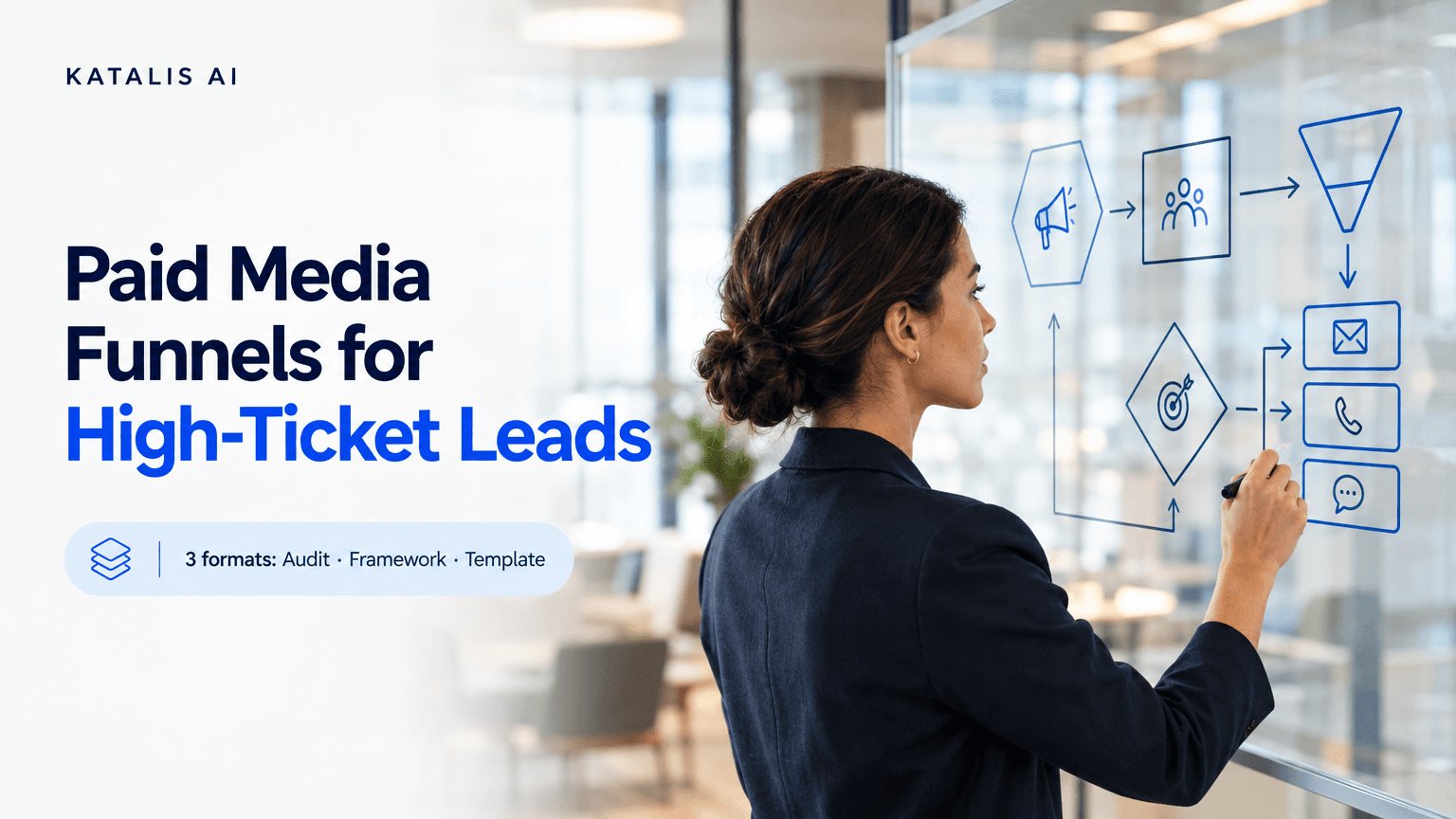
High-ticket service funnels require a layered paid media architecture that separates latent problem education from direct capture. Unlike low-friction e-commerce, high-value consulting, clinical, or enterprise contracts involve elongated evaluation windows and high perceived risk, meaning single-touch direct response models reliably produce low-intent inquiries, inflated intake costs, and poor sales velocity.
Key Takeaways
The Lead Quality Paradox: Lowering front-end cost-per-lead (CPL) through low-friction direct-response ads usually increases cost-per-acquisition by overwhelming sales teams with unqualified prospects.
Architectural Separation: Sustainable funnels segment paid media into distinct engines: demand generation (educating latent buyers), intent capture (harvesting active evaluators), and retargeting triage.
Friction as a Filter: Strategic friction in intake flows, such as qualification forms or consultative qualification steps, protects sales capacity and improves algorithmic optimization signals.
Downstream Optimization: Campaign success must be evaluated on cost-per-qualified-lead (CPQL) and pipeline velocity rather than raw conversion volume.
1. The High-Ticket Service Funnel Paradox: Why Direct Response Alone Fails
Transactional direct-response advertising is built on immediate utility, impulsive action, or low financial risk. A consumer can decide to purchase an apparel item or test a consumer product in minutes. In contrast, high-ticket services, whether enterprise advisory, specialized engineering, or high-end elective procedures, demand significant financial commitments, reputational risk, and multiple decision criteria.
When growth teams deploy a single direct-response ad targeting cold audiences with a heavy call to action (such as "Book a Consultation" or "Request a Custom Proposal"), two failure modes emerge:
The Ghost Prospect: Cold prospects do not possess sufficient institutional trust or problem awareness to commit their calendar. Click-through rates remain low, and customer acquisition costs spiral upward.
The Low-Intent Tsunami: If the offer is phrased loosely to maximize volume (such as "Free Growth Audit" or "Complimentary Discovery Call"), the ad platform optimizes for users prone to filling out forms rather than high-value buyers. Front-end CPL drops, but sales development representatives spend their hours fielding unqualified inquiries.
Solving this paradox requires shifting media architecture from a single transaction event into an intent qualification pathway.
2. Deconstructing the Mechanics of Multi-Touch Channel Architecture
A resilient high-ticket media system separates paid campaigns into distinct programmatic layers, each serving a defined operational objective:
Layer 1: Problem Clarification and Authority Calibration
The top layer focuses on latent demand. Most prospective clients in your addressable market are not actively searching for a provider today, but they are experiencing specific business or operational friction. Content in this tier highlights diagnostic frameworks, market realities, and teardowns of common industry failures. The goal is to accumulate high-intent engagement cohorts (such as deep video views or engaged content readers) without forcing a premature sales conversation.
Layer 2: Validation and Solution Architecture
Once prospects demonstrate initial interest, media spend shifts toward validating capability and establishing contrast. Mid-funnel delivery exposes qualified cohorts to proprietary frameworks, methodology comparisons, and client scenario breakdowns. This stage answers how your service solves root problems differently from incumbent alternatives, establishing the rationale required for significant budgetary commitments.
Layer 3: Friction-Aligned Conversion and Capture
The conversion layer targets prospects who have consumed mid-funnel proof assets or are actively executing search queries with high commercial intent. At this stage, the call to action is explicit and focused on intake. Rather than minimizing form fields to artificially reduce CPL, the intake mechanism introduces necessary friction to pre-qualify organizational fit, budget range, and immediate readiness.
3. Capturing vs. Generating Intent: Platform Dynamics in Regional Markets
High-ticket funnels must respect the behavioral boundaries of specific advertising channels and regional communication preferences.
Search Engines vs. Interruption-Based Social Channels
Search platforms capture explicit commercial intent. A user searching for specialized enterprise providers is already problem-aware and solution-seeking. In these environments, paid media should direct traffic directly to high-converting qualification pages with clear structural proof.
Conversely, paid social feeds interrupt users. Expecting a cold social user to immediately transition into a multi-thousand-dollar contract conversation is mathematically inefficient. Paid social should primarily generate and nurture latent demand, feeding retargeting pools and building search resonance over time.
Regional Intake Channels and Conversational Commerce
In developing digital markets and specific regional ecosystems, such as Southeast Asian markets, traditional multi-page web forms can introduce unintended drop-off. In these environments, target buyers frequently prefer conversational intake pathways, including direct messaging services or dedicated concierge channels. While the intake platform may shift from an email form to a conversational application, the underlying architecture remains unchanged: qualification criteria must still be embedded within the conversation before routing the prospect to senior sales staff.
4. Alignment Between Paid Media Touchpoints and Sales Intake Systems
The boundary between paid media and sales intake is where high-ticket funnels succeed or collapse. When marketing optimizes for raw lead submissions while sales demands vetted commercial opportunities, systemic inefficiency follows.
Using Intentional Friction to Protect Sales Bandwidth
High-friction intake is an asset for high-ticket services. A standard lead form requesting only a name, email address, and phone number produces poor algorithmic feedback. By adding qualifying dropdowns, such as current revenue thresholds, operational volume, or implementation timelines, the intake flow achieves two goals:
It filters out non-viable inquiries before they absorb expensive human triage capacity.
It provides granular conversion data that can be fed back into ad platform conversion APIs.
Closing the Algorithmic Data Loop
Modern ad network algorithms optimize toward whatever event they are instructed to prioritize. If you fire a standard lead pixel upon form completion, the ad network will optimize for users who submit forms cheaply, regardless of deal viability. Integrating customer relationship management (CRM) milestones, such as "Qualified Opportunity Created" or "Contract Sent," into the ad platform's feedback loop instructs the delivery engine to target audiences that match your actual paying clients.
5. Measuring Pipeline Health: Beyond Cost-Per-Lead to True Inquiry Value
Evaluating a high-ticket service funnel requires abandoning vanity metrics in favor of pipeline-centric measurement:
Cost Per Qualified Lead (CPQL): Total media investment divided by inquiries that meet strict minimum qualification criteria.
Pipeline Velocity: The average speed at which a qualified paid media lead transitions from initial click to signed engagement.
Sales Capacity Utilization: The percentage of available consultative hours spent with pre-vetted, high-probability opportunities versus unqualified discovery triage.
Contribution Margin per Acquisition: Realized revenue minus combined media spend and sales overhead required to close the engagement.
High-Ticket Funnel Audit Checklist
Before scaling paid media budgets for high-value services, review whether your funnel architecture meets these baseline requirements:
[ ] Separated Campaign Tiers: Are educational awareness campaigns segregated from direct conversion capture campaigns?
[ ] Explicit Qualification Criteria: Does your intake flow collect critical qualification markers (e.g., budget, timeline, project scope) rather than basic contact details?
[ ] CRM Feedback Integration: Are downstream sales qualification stages mapped back into ad platform conversion tracking?
[ ] Content Proof Assets: Does mid-funnel media deliver concrete evidence of capability and clear methodology contrast?
[ ] Unified Metric Alignment: Are growth and sales teams evaluated on qualified pipeline value rather than raw front-end lead numbers?
Malvin Aprilliano