
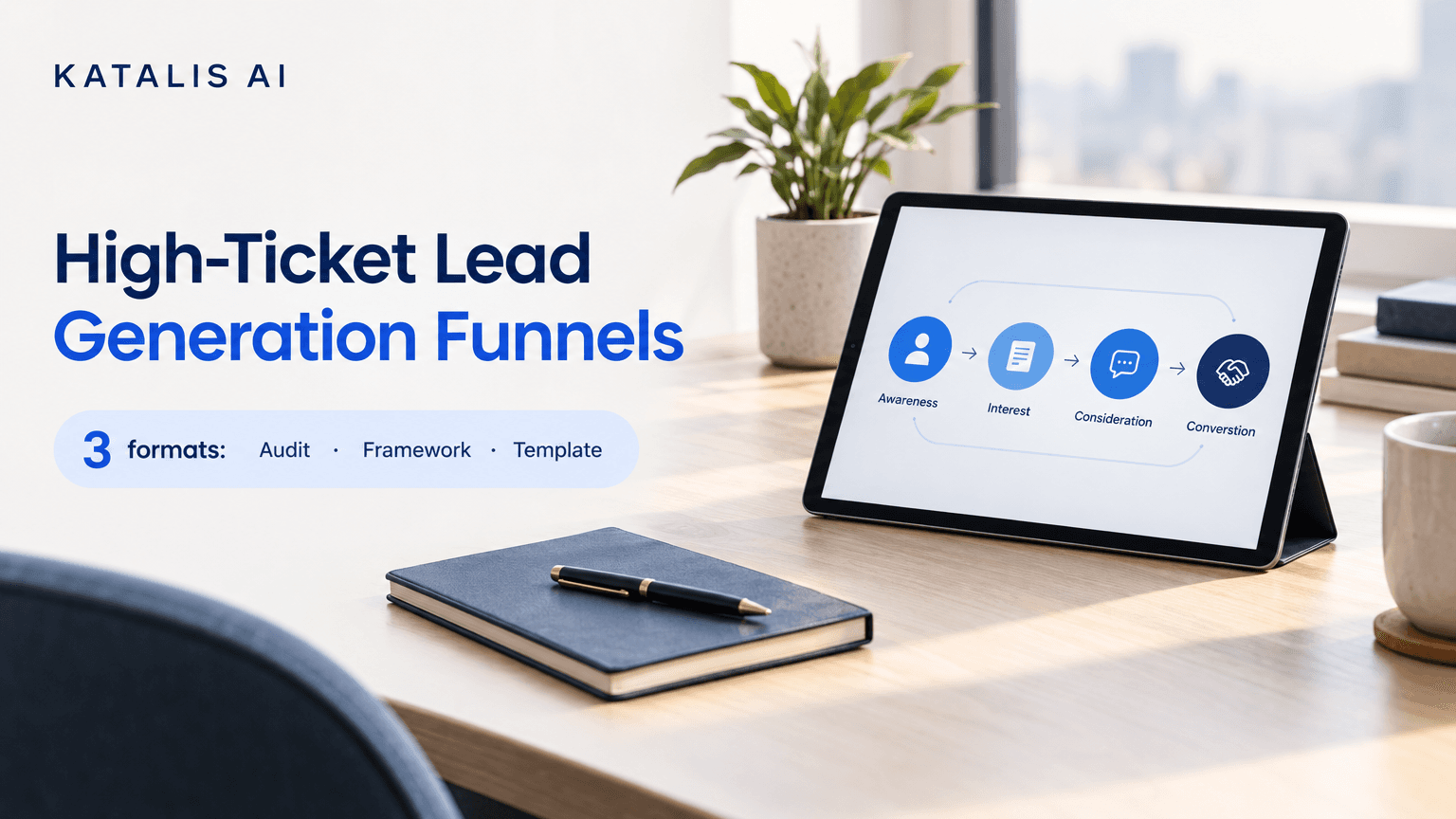
A high-ticket paid media funnel moves prospective clients through three stages. The top of the funnel captures existing search or industry demand. The middle builds technical credibility and lowers perceived risk. The bottom sends qualified prospects to a deliberately demanding intake form or a consultative discovery call.
The common thread is qualification. Each stage should filter out poor-fit prospects before they reach your sales team, not after.
Key takeaways
Volume is the wrong target. Optimizing for the lowest cost per lead (CPL) tends to fill the pipeline with inquiries your sales team cannot close.
Top-of-funnel spend should follow commercial intent. Use solution-focused search terms and firmographic targeting rather than broad reach.
The middle of the funnel runs on proof. Teardowns, methodology walkthroughs, and documented client outcomes do more work here than general awareness content.
Some friction at intake is useful. Multi-step qualification forms protect your team's consultation time.
Budget should reflect long buying cycles. Reserve enough spend for retargeting and high-intent conversion channels, not only cold acquisition.
Lead quality vs. lead volume
In high-ticket services, hundreds of cheap inquiries usually create a bottleneck rather than revenue. When forms are built purely for volume, salespeople spend consultation hours screening prospects who lack the budget, the authority to buy, or an immediate need.
A better measure of media efficiency is cost per qualified lead (CPQL) or cost per pipeline opportunity. Both tie ad spend to leads your sales team has accepted, rather than to raw form submissions.
This matters because buyers arrive later and better informed than many sales teams assume. Research from 6sense found that buyers typically complete about 69% of their journey before contacting a seller, and that 81% have already picked a preferred vendor by then (G2 Learn Hub, interview with 6sense's Kerry Cunningham). Gartner's 2024 survey of 632 B2B buyers found that 61% prefer a buying experience without a sales rep (Gartner). Your ads and content are often doing the early selling on their own.
Step 1: Top of funnel — target commercial intent
High-ticket buyers rarely buy on impulse. Top-of-funnel (TOFU) media should reach people who are already aware of a problem, or organizations whose profile suggests a clear operational pain.
Capture active intent through search
Bid on solution-oriented keywords instead of informational ones. A firm offering compliance advisory, for example, should favor terms describing the specific service over terms asking what compliance means.
Pair this with a maintained negative keyword list. Negative keywords stop your ads from showing on searches that contain terms you exclude (Google Ads Help). For high-ticket services, common exclusions include "free," "template," "jobs," and "course."
Target by account and role
On professional networks, build audiences from seniority, company headcount, industry, or the specific technical tools a company uses. These filters screen for fit more reliably than broad interest categories.
Qualify inside the ad itself
State your price floor, minimum engagement size, or client criteria in the headline or primary text. This discourages clicks from prospects who would never qualify, so less budget is wasted on them.
Step 2: Middle of funnel — prove you can deliver
High-value engagements involve large financial commitments and often organizational change. Prospects want solid evidence before they book a consultation, and the middle of the funnel (MOFU) supplies it.
MOFU campaigns usually retarget people who have already shown interest: landing page visitors, video viewers, and social engagers. Instead of asking for a sales call straight away, these ads should deliver substance:
Detailed case studies. Show the starting metrics, the implementation steps, and the measured results for a client similar to the prospect.
Your methodology. Use video breakdowns or ungated teardowns to show how you work and why it works.
Comparison and evaluation guides. Lay out the trade-offs between doing the work in-house, buying off-the-shelf software, and hiring a specialist provider.
Step 3: Bottom of funnel — conversion and intake routing
The bottom of the funnel (BOFU) moves qualified traffic toward one decisive action: booking a discovery session, requesting an audit, or submitting a project brief. The intake step must collect enough context for your team to prepare, without putting off serious buyers.
Add friction on purpose
A standard form asking only for name, email, and phone number gives your team too little to work with. Add qualifying fields such as annual revenue band, current software stack, expected project timeline, or the business objective behind the inquiry.
Choose between direct booking and application review
Let prospects who match your ideal client profile (ICP) book directly into a calendar, so you lose as little momentum as possible. Send submissions that fall outside your criteria, or that need a closer look, to an automated vetting workflow or an internal review queue.
Respond quickly
Speed still matters at this stage. A widely cited Harvard Business Review audit of 2,241 US companies found that firms trying to reach a lead within an hour were nearly seven times as likely to qualify it as firms that waited longer (HBR, 2011; summary via CustomerThink). Setting an internal target, such as responding to or routing qualified requests within 15 minutes, keeps that window from closing.
Budget allocation across the funnel
High-ticket B2B and professional services usually have long sales cycles. That calls for a budget spread that does not pour everything into cold acquisition while starving retargeting and conversion.
The split below is a starting point for an established paid media mix, not a benchmark. Adjust it to your sales cycle length, the size of your retargeting pools, and the conversion data you collect. If you advertise across Indonesia, Malaysia, and Singapore, check each market's own platform and conversion data rather than applying one split to the whole region.
Funnel stage | Suggested share of budget | Typical uses |
|---|---|---|
Cold intent and capture | 50–60% | High-intent paid search, targeted industry placements, account-based advertising |
Mid-funnel validation and retargeting | 25–30% | Sequenced social retargeting, case study distribution, value-focused video |
Bottom-of-funnel conversion | 15–20% | Branded search, direct-booking campaigns, retargeting to revive stalled deals |
Measurement: optimize for pipeline, not form fills
Ad platforms optimize toward whatever conversion you report. If you only send them form submissions, they will find you more form submissions, whatever their quality.
The fix is to pass downstream outcomes from your CRM back to the platforms. Google recommends choosing a lead-specific goal such as "qualified lead" or "converted lead," uploading offline conversion data ideally every day, and using value-based bidding when you can assign different values to different leads (Google Ads Help). Google now recommends enhanced conversions for leads over the legacy offline conversion import (Google Ads Help).
High-ticket intake checklist
Define what counts as a marketing qualified lead (MQL) and a sales qualified lead (SQL), using criteria such as revenue, team size, and timeline.
Audit negative keyword lists, starting with the exclusions in Step 1.
Build multi-step lead forms with required qualification fields.
Set up server-side conversion tracking and CRM sync so platforms optimize for pipeline value, not lead volume.
Set a response or routing target for qualified discovery requests, such as 15 minutes.
Frequently asked questions
Should high-ticket services avoid native lead forms?
Not always, but use them carefully. Native forms such as LinkedIn Lead Gen Forms pre-fill fields from the member's profile, so a prospect can submit in a couple of clicks (LinkedIn Help). That ease lowers cost per lead but can also attract low-intent submissions.
If you use native forms, add friction back in. Meta's instant forms offer a "Higher intent" type that adds a review screen before submission (Jon Loomer Digital), and most platforms let you add custom qualifying questions. Where lead quality stays poor, send prospects to a dedicated landing page with a qualification form instead.
How long should prospects stay in mid-funnel retargeting?
Match the retargeting window to your average sales cycle. If clients typically take 60 to 90 days to evaluate and sign, keep mid-funnel campaigns running for at least 60 days. Refresh the creative every two to three weeks to limit ad fatigue.
What is the most important metric for a high-ticket funnel?
Cost per pipeline opportunity is the most reliable primary metric, tracked alongside how quickly sales-accepted leads (SALs) move through your pipeline. Click-through rate (CTR) and cost per click (CPC) are useful for diagnosing problems, but they do not tell you whether the funnel is producing revenue.
Malvin Aprilliano