
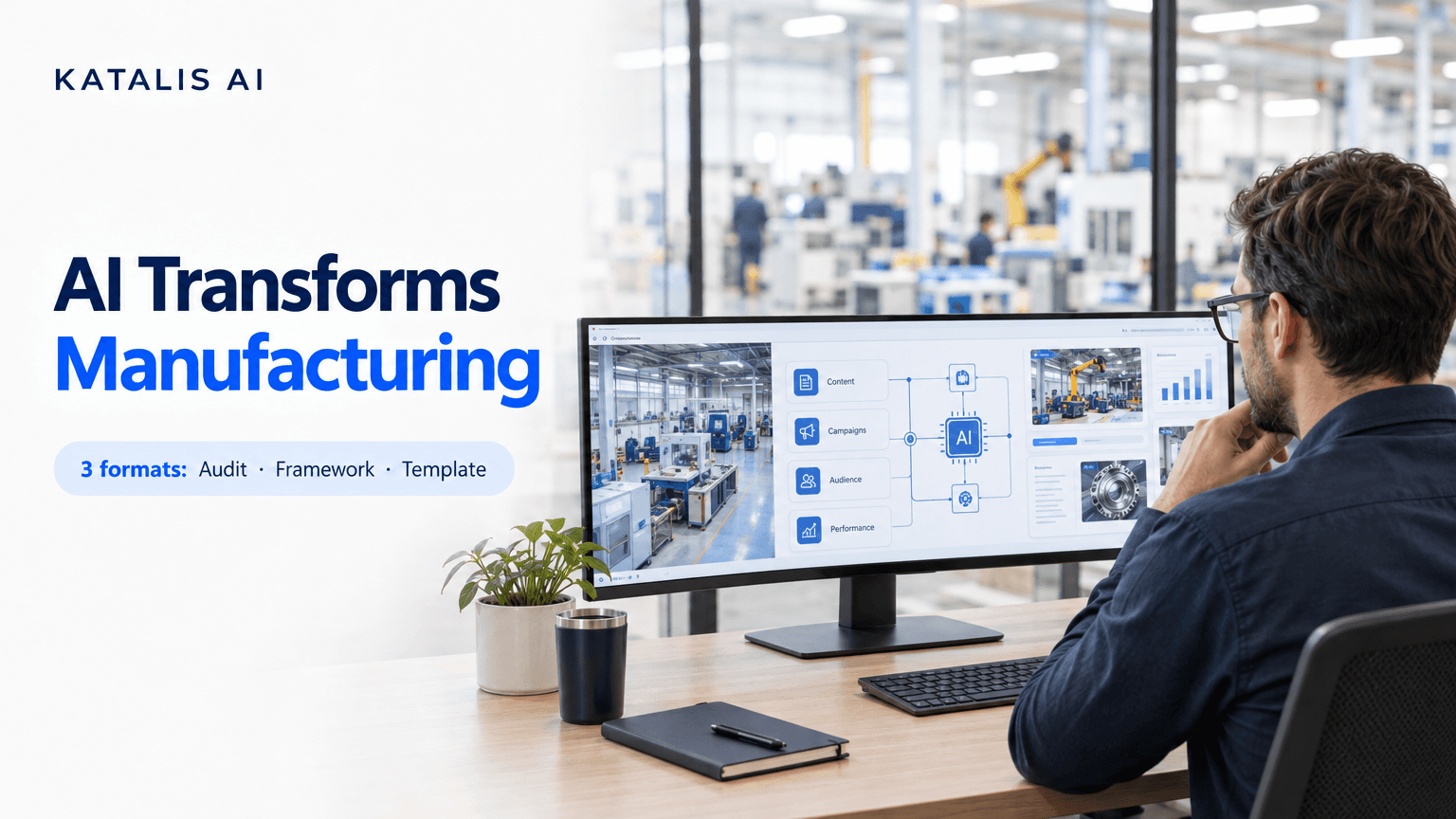
Artificial intelligence is transforming manufacturing digital marketing by replacing manual, static lead generation with predictive audience targeting, automated content personalization, and real-time inquiry qualification. Rather than relying on generic brochures and trade shows, industrial marketers can now systematically identify buying committee intent, match technical documentation to buyer requirements, and route requests for quotation directly to the right engineering teams.
Key Takeaways
From Reactive to Predictive: Industrial AI marketing shifts operations from static trade promotion to intent-driven account engagement.
Complex Buying Cycles: AI models map multi-stakeholder purchasing teams across procurement, design, and operations.
Technical Integrity First: AI-assisted workflows require strict human-in-the-loop governance to maintain engineering specifications and industry compliance.
Foundational Data Readiness: Effective AI adoption depends on structured customer relationship management data, standardized product specs, and clean technical documentation.
The Operational Shift: Traditional vs. AI-Assisted Manufacturing Marketing
Industrial marketing has historically operated on long sales cycles, relationship-driven sales, and manual customer touchpoints. Digital campaigns frequently struggled because industrial buyers do not make impulsive purchases. A typical manufacturing transaction involves engineers checking tolerances, procurement specialists evaluating supply terms, and executives balancing capital expenditures.
Traditional industrial marketing treats these stakeholders with a broad brush, pushing generic whitepapers or waiting for inbound website forms. In contrast, an AI-assisted marketing workflow evaluates behavioral signals across technical pages, spec sheet downloads, and digital catalog interactions. The operational focus moves from surface-level lead generation to deep qualification of industrial intent.
Core Applications of AI in Manufacturing Digital Marketing
1. Precision Account and Buying Committee Identification
Manufacturing procurement rarely relies on an individual decision-maker. AI-driven segmentation algorithms analyze organizational data, digital footprint patterns, and engagement velocity to map the entire buying unit. Marketing teams can distinguish when an operational manager is conducting exploratory research versus when a design engineer is validating exact CAD configurations for a planned production run.
2. Technical Content Matching and Documentation Delivery
Industrial buyers require technical validation before they engage with sales teams. AI mechanisms enable dynamic asset delivery, serving precise material safety data sheets, tolerance charts, or compliance certificates based on a visitor's recorded application context. Rather than forcing prospects to navigate complex product libraries manually, intelligent content pipelines surface the exact specifications needed for technical evaluation.
3. Automated Inquiry Triage and RFQ Routing
Inbound requests for quotation (RFQs) vary widely in quality and scope. Some inquiries represent viable multi-year production agreements, while others represent low-volume requests outside operational capabilities. Natural language processing systems can parse incoming inquiries, extract key operating parameters such as volume, material type, and timeline, and immediately assign high-priority leads to technical sales engineers while routing standard requests to automated self-service paths.
Preserving Technical Accuracy and Brand Positioning
While AI brings operational speed, manufacturing marketing carries high risk regarding factual accuracy. Providing inaccurate load limits, chemical tolerances, or delivery capabilities damages commercial trust and can create contractual liability. Industrial companies adopting AI must establish strict quality safeguards:
Human-in-the-Loop Review: AI tools should draft or organize content, but qualified technical personnel or applications engineers must review technical datasheets and capability statements prior to release.
Closed-Domain Training: AI systems used for automated prospect interactions should be restricted to verified company documentation and established catalog parameters, preventing hallucinated specifications.
Brand Positioning Protection: High-end manufacturers relying on precision, safety, and reliability must ensure automated copy does not dilute their positioning with generic promotional claims.
Prerequisites for Manufacturing AI Marketing Adoption
Deploying AI tools without clean foundational processes leads to fragmented operations. Before introducing automated tools, industrial organizations should ensure three foundational elements are in place:
Clean Technical Data Architecture: Product specifications, CAD assets, case studies, and compliance certifications must be organized in standardized, accessible digital formats.
Sales and Marketing SLA Alignment: Clear criteria must be established defining what qualifies as an engineering-ready RFQ versus an exploratory marketing lead.
Centralized CRM Integration: Customer data and digital touchpoints must flow into a unified database so algorithmic models have accurate historical context.
Industrial Marketing AI Readiness Checklist
[ ] Digital product catalog and technical specifications are structured and up to date.
[ ] High-value RFQ criteria are clearly defined between sales and marketing teams.
[ ] Data privacy and proprietary engineering safeguards are established for all external platforms.
[ ] Human review workflows are defined for any AI-generated technical materials.
[ ] Website analytics and CRM platforms are integrated to capture multi-touch interaction history.
Frequently Asked Questions
Does AI marketing replace industrial sales engineers?
No. In manufacturing, technical sales engineers remain essential for solution design, commercial negotiation, and contractual review. AI handles early-stage qualification, intent detection, and content routing, allowing sales engineers to focus their time on high-probability opportunities.
How do industrial companies prevent AI from misstating engineering specifications?
Companies should ground their marketing systems exclusively in verified internal documentation using closed-context retrieval models. Additionally, strict human review protocols must ensure that no technical claim is published or dispatched without engineering sign-off.
What is the first step for a mid-sized manufacturer exploring AI marketing?
The practical starting point is auditing existing customer touchpoints and organizing digital product assets. Implementing automated inquiry sorting and intent-based content recommendation on an existing website typically offers rapid operational improvements without overhauling core systems.
Admin One